Get the app
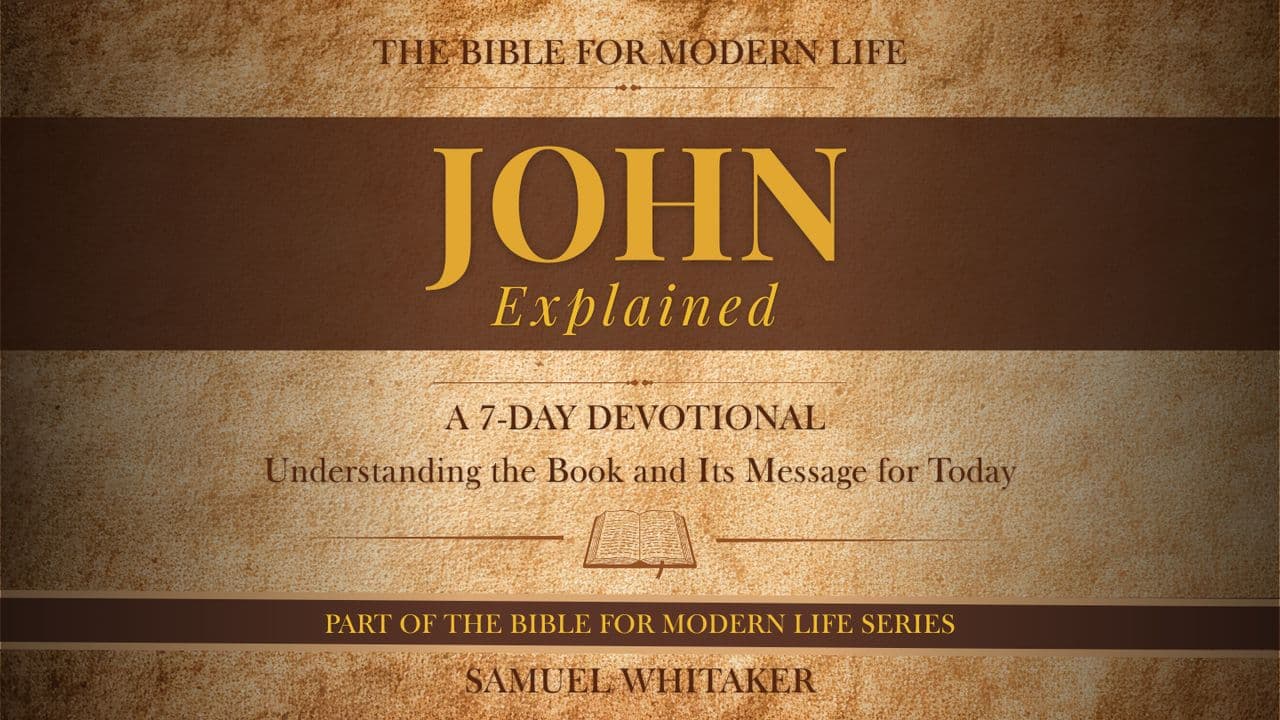
JOHN EXPLAINEDSample
What We Get Wrong About John
John’s Gospel is the most misread of the four, partly because its cosmic opening gives readers permission to keep it at a comfortable theological distance. Several misreadings are common enough to be worth naming.
The first is treating the prologue as a theological preamble rather than a personal claim. The Word became flesh. Not a principle. Not a category. Flesh — with all the specific, physical, embodied particularity that the word implies. The God of John’s Gospel is not a God who observes the human situation from outside and occasionally intervenes. He is the God who entered it so specifically that those who were present could touch what they had seen and heard and testify to it. The formation this lesson requires is the gradual replacement of a God who is abstractly present with a God who is concretely near.
The second misreading treats eternal life as exclusively future — the guaranteed afterlife secured by believing, whose primary relevance to the present is the motivation it provides for wise choices. John’s own definition dismantles this before it can settle: this is eternal life, that they know you, the only true God, and Jesus Christ, whom you have sent. The definition is relational and present-tense. Eternal life is not a future state entered after death. It is the quality of existence that belongs to knowing God — a knowing that begins now, in the present engagement with the one who is the way and the truth and the life.
A third misreading reads the Farewell Discourse as a historically bounded address to the eleven disciples, applicable to subsequent readers only by analogy. The High Priestly Prayer of chapter seventeen dismantles this explicitly. Jesus prays for those who will believe in him through their testimony — every subsequent generation of the church, named in the prayer before they have come into existence. The Farewell Discourse is not a conversation that later readers overhear. It is addressed to every disciple in every generation willing to receive it.
The most common misreading of all is maintaining a comfortable distance from the encounters John narrates — appreciating the text as literature or theology while insulating oneself from the demand the encounters generate. John’s Jesus cuts past every presented question to the actual one beneath it. He does not engage Nicodemus’ opening compliment. He does not let the Samaritan woman’s theological deflection redirect the conversation. The Gospel was written to produce the same quality of encounter in the reader. It was not written to be admired.
REFLECTION QUESTIONS
1. Which of these misreadings most accurately describes your previous engagement with John — keeping the prologue at theological distance, treating eternal life as future, or maintaining the comfortable distance that protects you from the encounter?
2. John’s Jesus asks Thomas not to stop short of the wounds. Where in your own engagement with the Gospel are you stopping short of the most demanding dimension of what it is asking?
TODAY’S PRACTICE
Read John 3:1–15 today — Nicodemus at night. Notice what Jesus does with the opening compliment: he ignores it and goes straight to what the conversation is actually about. Then ask honestly: what is the actual question you have been bringing to this Gospel beneath the presented one? What is the thing underneath?
Scripture
About this Plan
The Gospel of John begins before the world did — In the beginning was the Word. Of the four Gospels, it is the most theologically concentrated and the most personally searching. It was written for people who were not there and who are nonetheless called to the same faith those experiences produced. Over seven days, this plan traces John’s deepest claims: the Word made flesh, the seven signs, the encounters that cut past every presented question to the real one underneath, and the question the risen Jesus keeps asking: do you believe this?
More
We would like to thank Samuel Whitaker for providing this plan. For more information, please visit: https://www.samuelwhitaker.net