Get the app
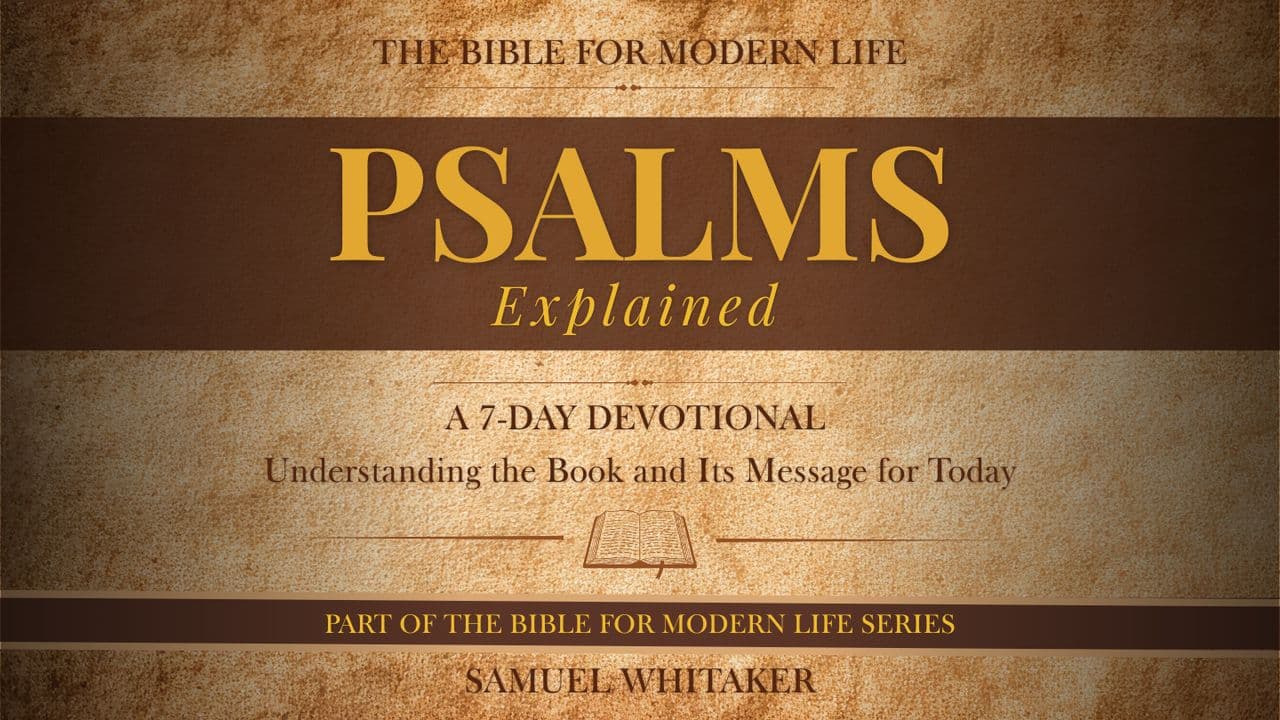
PSALMS EXPLAINEDSample
A Conversation Still Open
The book of Psalms ends with praise. Psalm 150 is pure, unqualified, all-in celebration: praise God in his sanctuary, praise him in his mighty heavens, let everything that has breath praise the Lord.
But it ends there after 149 preceding poems — many of them lament, many of them unresolved, many of them sitting in the kind of darkness that does not offer easy exits. The final praise is not naive. It is a declaration made by a book that has already said everything else. It has already asked “How long?” and “Why have you forsaken me?” and “Why do you stand far off?” The praise at the end does not retract any of those questions. It simply affirms, after all of them, that God is still worthy of worship.
That is a different kind of confidence than one that has never been tested. And it is the kind of confidence the Psalms consistently model.
For modern readers, this final posture is the Psalms’ deepest invitation. Not to feel a particular thing. Not to arrive at a particular conclusion. But to maintain a particular orientation — turning toward God through joy and grief alike, through certainty and confusion, through praise that comes easily and lament that does not resolve. The writers of the Psalms maintained that posture across very different circumstances, and what they left behind is evidence of how much that posture can hold.
The conversation the psalmists began has not concluded. Every person who reads these poems with genuine attention becomes part of it — not as a passive recipient, but as someone whose own experience now enters into dialogue with the voices the book preserves. Your questions belong in that conversation. Your grief belongs. Your gratitude belongs. Your unresolved seasons belong.
The invitation the Psalms extend is the same one it has always been: bring what is real, speak honestly, remember what has come before, and remain in the conversation. Even when — perhaps especially when — the answers have not yet arrived.
REFLECTION QUESTIONS
1. How has your understanding of the Psalms — or of prayer itself — shifted over these seven days?
2. What would it look like for you to maintain the posture the Psalms model — honest, persistent, turned toward God — in the season of life you are currently in?
TODAY’S PRACTICE
Read Psalm 150 today as the closing word of a long conversation — one that included everything else the Psalms have said. Then sit quietly for a few minutes. You do not need to produce praise or resolve what is unresolved. Simply remain in the conversation that the Psalms have been keeping open for thousands of years. That, too, is faithfulness.
We adapted this plan from Psalms Explained, part of the Bible for Modern Life Series. Want more content like this? Explore other books in the series at samuelwhitaker.net .
Scripture
About this Plan
The Psalms are the Bible’s most emotionally honest book — not a collection of feel-good verses, but a record of how real people brought everything they were carrying into an unfiltered conversation with God. Over seven days, this plan explores what it means to pray honestly, to worship through difficulty, to use memory as a weapon against despair, and to belong to a community that carries what you cannot carry alone. Whatever season you are in right now, the Psalms were written for it.
More
We would like to thank Samuel Whitaker for providing this plan. For more information, please visit: https://www.samuelwhitaker.net