Get the app
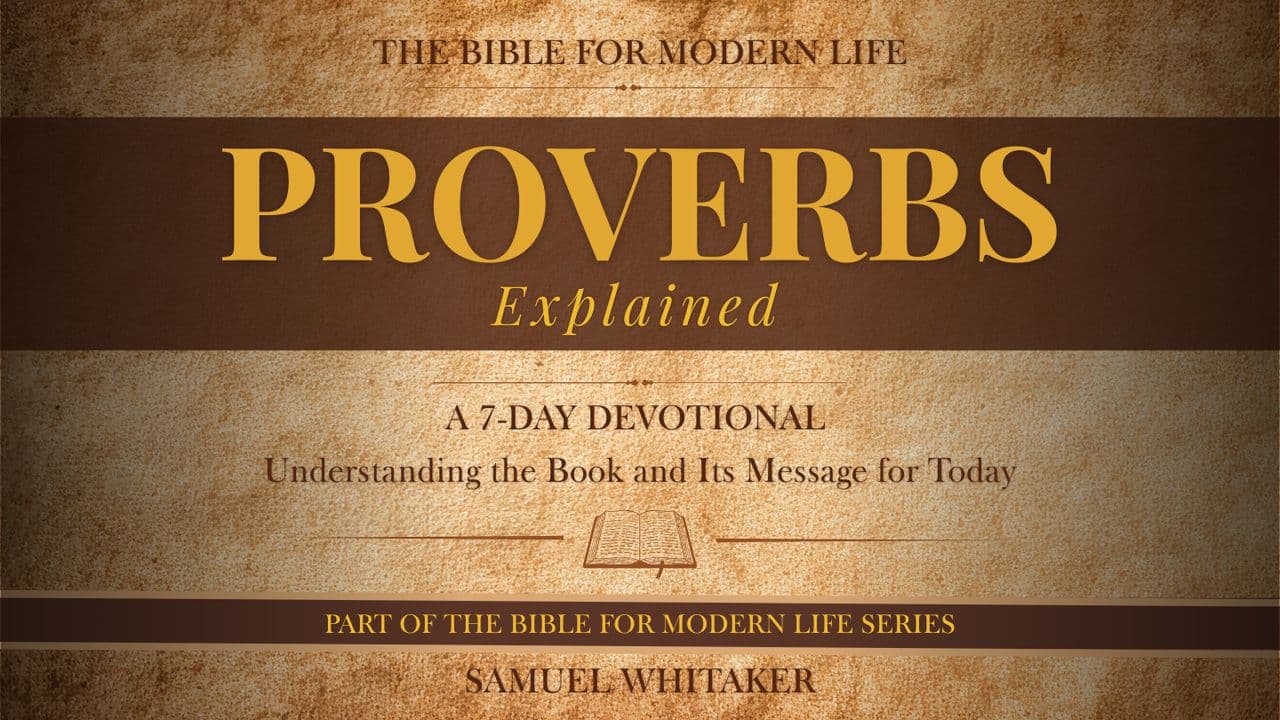
PROVERBS EXPLAINEDSample
The Question Behind the Sayings
Every culture in human history has tried to answer the same question: what does it actually mean to live well? Not just successfully. Not just comfortably or in a way that is admired by others. But genuinely, deeply, actually well — in a way that holds up under pressure and proves durable over time.
The book of Proverbs is Israel’s sustained answer to that question.
What makes Proverbs unusual is how it approaches the question. It does not start with philosophy or abstract argument. It starts with observation — with people paying careful attention to how human life actually unfolds. What happens when a person consistently lies? What does pride cost, over time? What does it mean to have a friend who tells you the truth? What is the slow consequence of avoided responsibilities? The sages watched, and what they watched, they recorded.
But here is the turn that shapes everything: Proverbs does not treat wisdom as a purely human achievement. The foundational claim of the book — stated near the beginning and returned to throughout — is that the fear of the Lord is the beginning of wisdom. Not the conclusion. Not the reward. The beginning.
This matters because it reframes the entire enterprise. Wisdom in Proverbs is not primarily about being clever, well-read, or experienced. It is about posture — about approaching life, yourself, and other people with a genuine humility that acknowledges you are not the measure of all things. That humility, the book insists, is not weakness. It is the condition that makes genuine wisdom possible. Pride closes off growth. Humility opens it up.
The question Proverbs is asking is not academic. It is the question every person enacts by the pattern of their daily choices, whether or not they have ever consciously considered it. What kind of person am I becoming? And is that person someone I would actually want to be?
REFLECTION QUESTIONS
1. When you think about what it means to live well, what comes to mind first — achievement, comfort, relationships, character? How does Proverbs’ answer compare to yours?
2. What would it mean practically for you to approach your life, your decisions, and your relationships with the humility Proverbs calls the beginning of wisdom?
TODAY’S PRACTICE
Read Proverbs 9:10 and sit with this: the fear of the Lord is the beginning of wisdom — not something you arrive at after becoming wise, but where wisdom starts. What would it look like today to begin there, before the day asks anything of you?
Scripture
About this Plan
Proverbs is not a collection of spiritual fortune cookies. It is a carefully designed invitation to pursue a life shaped from the inside out by wisdom, integrity, honest speech, and genuine humility before God. Over seven days, this plan traces what that invitation actually means — what wisdom is, how character forms, why the way we speak matters more than we realize, and what it looks like when a whole life becomes the embodiment of what the book has been pointing toward.
More
We would like to thank Samuel Whitaker for providing this plan. For more information, please visit: https://www.samuelwhitaker.net