Get the app
And He LivedSample
Faithful to God
He blessed them that day and said,
“In your name will Israel pronounce this blessing:
‘May God make you like Ephraim and Manasseh.’” — Genesis 48:20
I want to tell you about one of the most beautiful customs in Jewish life. It takes place on Friday night, which is the beginning of Shabbat. After everyone comes home from the evening Shabbat service in the synagogue, we gather around the table for Shabbat dinner. The room is illuminated by the Shabbat candles that I, as the mother of the house, lit just before sundown. The two loaves of challah bread are covered with a beautiful cloth. After singing songs welcoming the angels of Shabbat and praising the woman of the house with Proverbs 31, the father of the family blesses each of his children.
As he lays his hands on the head of each of his children, a Jewish father begins his blessing for boys with “yesimcha Elohim ke’Ephraim u’Menashe,” “May God make you like Ephraim and Manasseh.” For girls, the father will begin, “yesimcha Elohim ke’Sarah, Rivkah, Rachel, ve’Leah,” “May God make you like Sarah, Rebekah, Rachel, and Leah.” The father’s blessing continues with the three verses of blessing from Numbers 6, known as the priestly blessing, pronounced over each child with their father’s hands laid upon their heads.
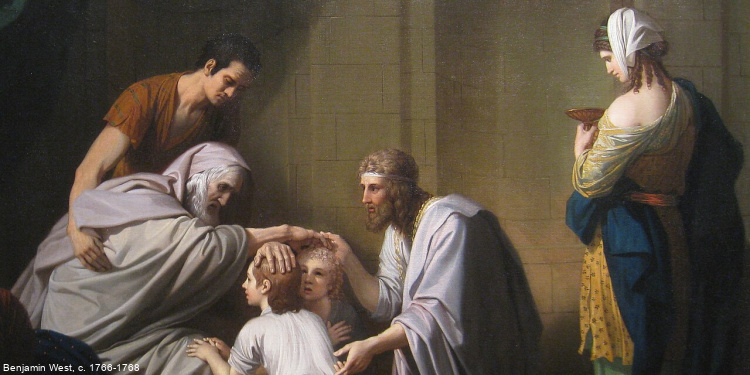
The origin of this beautiful custom is found in this Scripture. Near the end of his life, Jacob laid his hands on the heads of his grandchildren, Ephraim and Manasseh, and blessed them. At the end of this blessing, he told the two boys that Israel would pronounce blessings over their children in their names. So why do we bless girls with the names of the Matriarchs? And why did Jacob say that all Israel would forever bless their children, invoking the names of Ephraim and Manasseh?
Unlike all the other children and grandchildren of Jacob at that time, only Ephraim and Manasseh were born and raised in Egypt. They grew up far away from the influence of Jacob and the rest of the family. Ephraim and Manasseh were surrounded by pagan Egyptian culture. Despite this environment, they stayed true to the faith of their ancestors—Abraham, Isaac, and Jacob. The same can be said of Sarah, Rebekah, Rachel, and Leah, who, unlike their husbands, were all raised by pagan parents and were faithful to God despite their upbringing.
By invoking Ephraim, Manasseh, and the Matriarchs, Jewish parents bless their children that they should have the strength to remain faithful to God, even in a hostile culture.
•Unless otherwise noted, all Bible verses in this plan are from the New International Version (NIV).
Scripture
About this Plan
For millennia, God’s people have been carrying out a weekly Bible study plan. Every year, they read through the Torah from Genesis to Deuteronomy. In synagogue each week, they read and study a Bible passage—the weekly parshah. This week’s parshah is called “Vayechi,” which is Hebrew for “and he lived,” and covers Genesis 47:28-50:26.
More
We would like to thank International Fellowship of Christians and Jews for providing this plan. For more information, please visit: https://ifcj.org