Get the app
And He Shall Be Called: Advent Devotionals, Week 5Sample

Advent Day 37: Lord of All
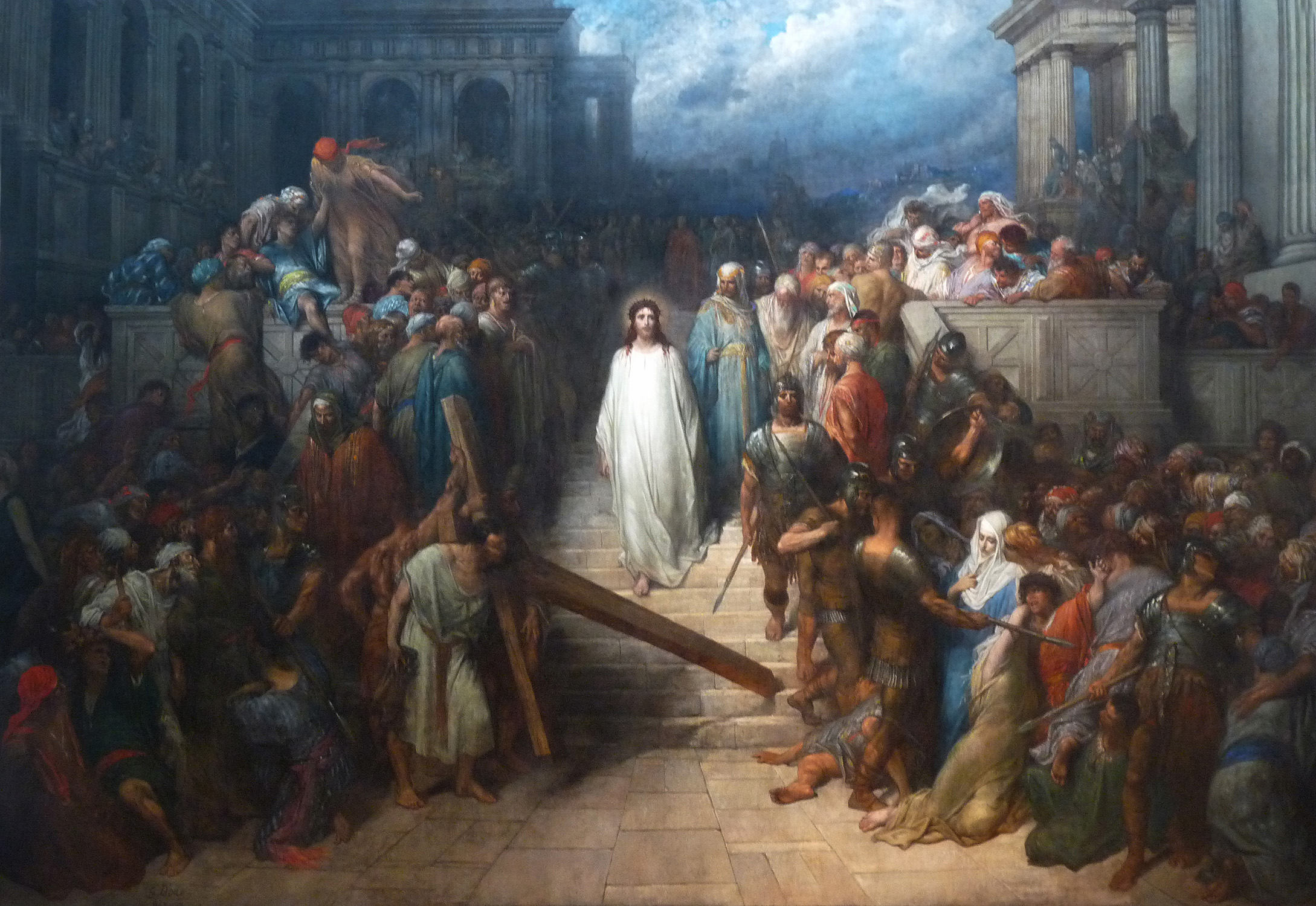
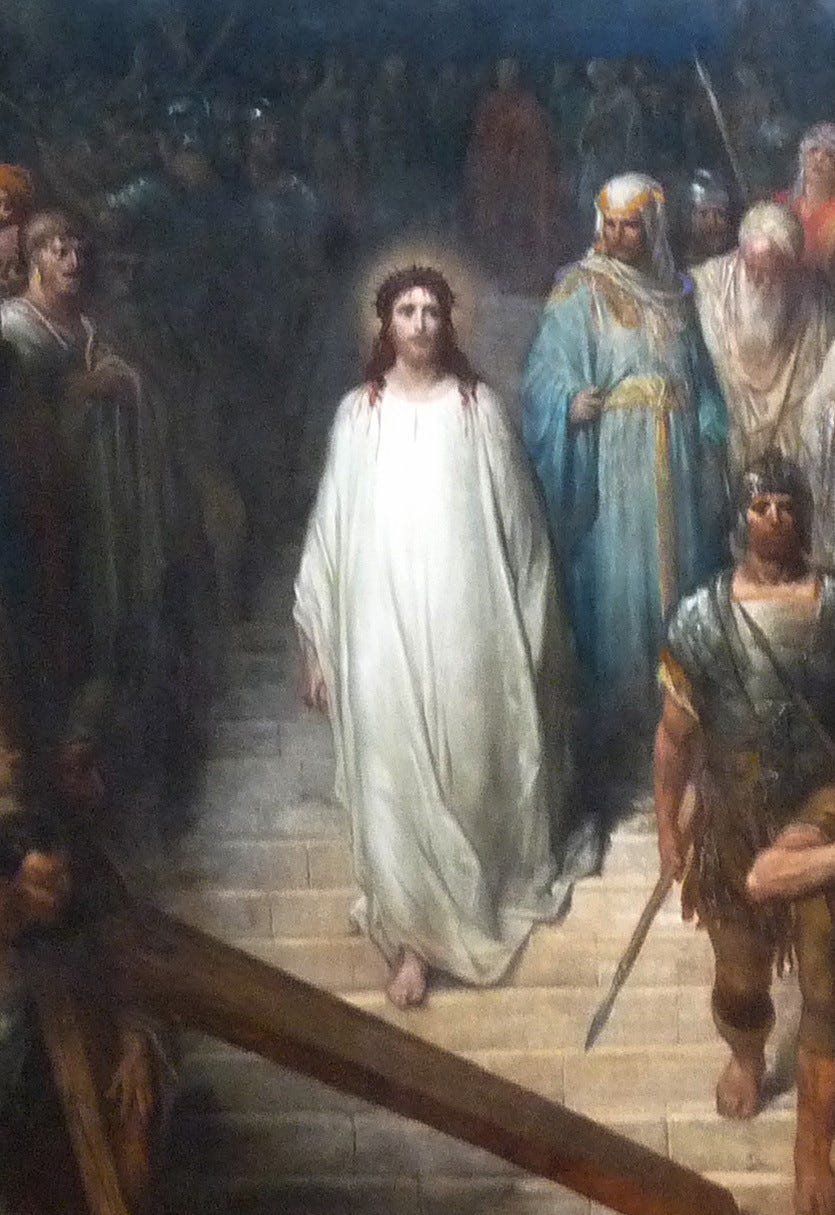
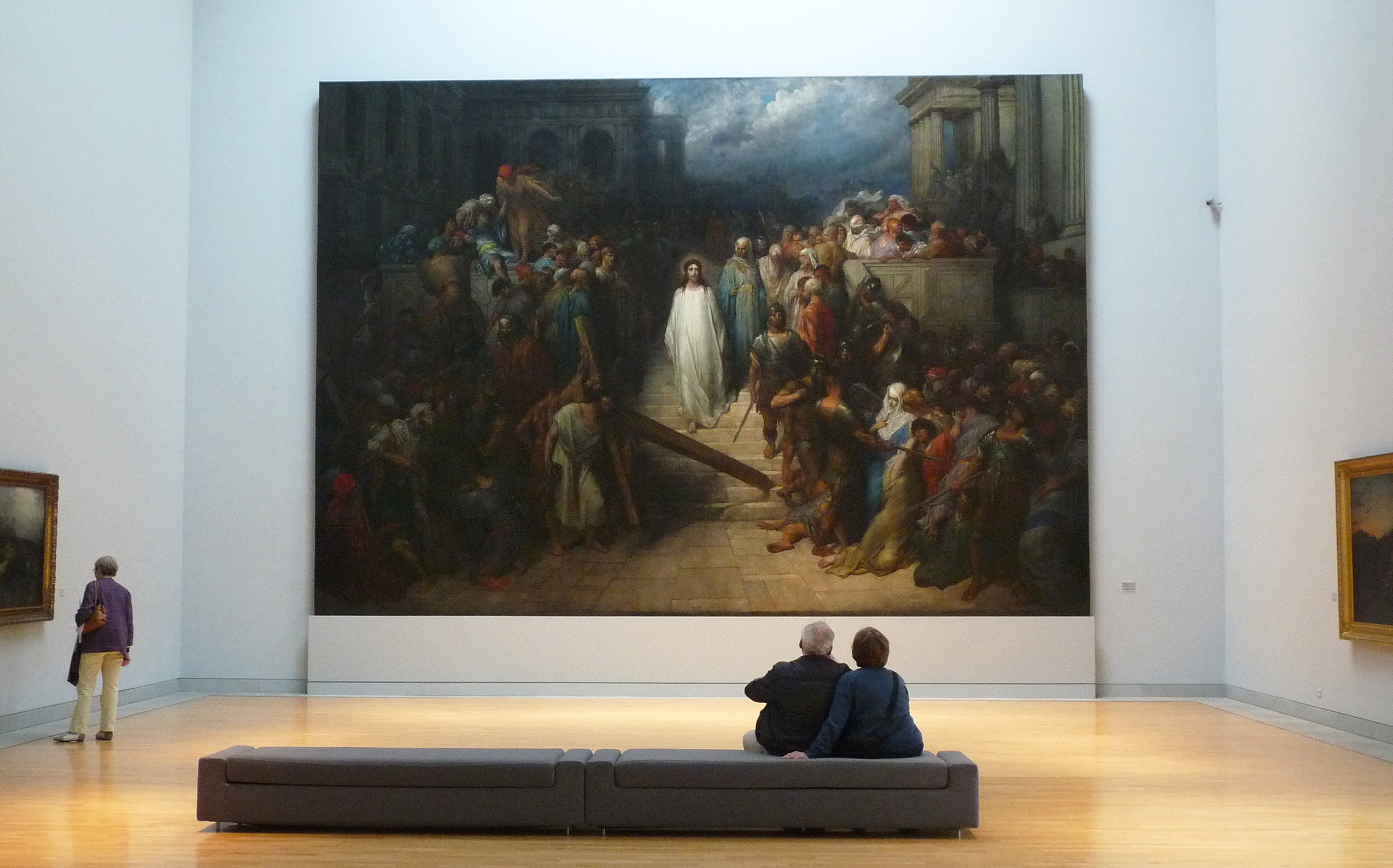
Christ Leaving the Praetorium (Christ Quittant le Prétoire), Gustave Doré, 1874–1880. Oil on canvas, 240 × 360 in. Strasbourg Museum of Modern and Contemporary Art, Strasbourg, France. Public Domain.
“Who Is He in Yonder Stall” from the album Feels Like Christmas, performed by Collingsworth Family Singers, composed by Benjamin Hanby and Patricia Pope.
“The Name of Jesus” from the album Folk Anthems for Choir, performed by Beckenhorst Singers, lyrics by Edward Perronet, music by Craig Courtney.
Poetry:
Wir dürfen dich nicht eigenmächtig malen
by Rainer Maria Rilke
(translated by Anita Burrows and Joanna Macy)
We must not portray you in king’s robes,
you drifting mist that brought forth the morning.
Once again from the old paintboxes
we take the same gold for scepter and crown
that has disguised you through the ages.
Piously we produce our images of you
till they stand around you like a thousand walls.
And when our hearts would simply open,
our fervent hands hide you.
Lord of All
Tomorrow begins the Feast of Epiphany, and traditionally Advent reflections shift from the twelve days of Christmas toward the recognition, journey, and gifts of the Magi. The visit and tribute of the noble travelers from the East is a key early sign that the baby born to Mary and Joseph in Bethlehem wielded authority and power that were not immediately obvious. Herod’s response to the visit of the Magi revealed that he would stop at nothing to maintain power.
As Jesus walked the earth and eventually began His public ministry, those invested with earthly authority, be it religious, political, scholarly, or economic, had to situate themselves in relation to this Man who bore authority naturally and gently. Then, as now, abusers of power were ever-present, seeking to obtain, and maintain, and wield lordship for personal advantage, or to impose their societal vision. To these “lords” Jesus was a frustrating enigma at best, and a threat to their positions and the established order at worst.
Gradually, through His teaching, signs, and deeds, He (mostly) gently asserted and demonstrated his authority over the various domains of nature and human life. Recognition of His authority often came from those outside of His own community. The Magi brought tribute, the Roman Centurion in Luke 7 intuitively understood the authority of Jesus, and even Pilate, for all his political dealing in half-truths, writes that Jesus is the “King of the Jews.” Of course, all of these are moments of testimony, though the attestants could only have understood the thousandth part.
Gustave Doré’s monumental oil painting Christ Leaving the Praetorium depicts Jesus walking out of his final interaction with the powers of his age. Doré shows Jesus as the central figure, walking out under his own power, a luminous figure in a mostly dark space. Doré’s painting is a reminder that even at the moment when Jesus seemed most subject to the earthly authority, He was still orchestrating the events and circumstances that would bring about His redemptive suffering and death. Jesus is Lord of Pontius Pilate, though Pilate certainly didn’t know it at the moment he sentenced Jesus to death. Jesus is Lord of Jerusalem, Lord of Rome, Lord of the highest and the lowest, and He willingly laid down his life.
Today’s poem by Rainer Maria Rilke is a favorite of mine. I am a painter by training and trade, and this phrase by Rilke reminds me that no image, not even one as beautifully wrought as Doré’s, is capable of expressing the Lordship of Christ. The penultimate line reminds me that the only appropriate response to Christ’s Lordship is for my heart to “simply open.” Our response to the Lordship of Christ (an eternal reality whether we understand it or not), is to yield, to open our hearts in love. This is what Jesus offers to us first, the Incarnation is the ultimate expression of loving openness and vulnerability from the One who rules all things, and in whom all things hold together. This mystery is beyond beautiful, and as Rilke suggests, is beyond any picturing.
Prayer (A Declaration):
Jesus, You are Lord
Lord of stars and dark matter
Lord of chirping crickets in cool autumn nights
Lord of nations and neighborhoods
Lord of feasting and fullness
Lord of the hungry and hurting
You are Lord of the powerful,
And Lord of the weak.
You are Lord of my enemies
And of those who find enmity in me.
With absolute dominion over all,
Your heart is open to every one of your creatures.
All praise belongs to You.
Amen.
Jonathan Puls, M.F.A., M.A.
Chair of the Art Department
Associate Professor of Art History and Painting
Biola University
About this Plan
Biola University's Center for Christianity, Culture & the Arts is pleased to share the annual Advent Project, a daily devotional series celebrating the beauty and meaning of the Advent season through art, music, poetry, prayer, Scripture, and written devotions. The project starts on the first day of Advent and continues through Epiphany. Our goal is to help individuals quiet their hearts and enter into a daily routine of worship and reflection during this meaningful but often hectic season. Our prayer is that the project will help ground you in the unsurpassable beauty, mystery, and miracle of the Word made flesh.
More
Related plans

Decide to Be Bold: A 10-Day Brave Coaches Journey
A Spirit-Filled Life

7 Ways to Grow Your Marriage: Wife Edition

The Key of Gratitude: Accessing God's Presence

A Word From the Word - Knowing God, Part 2

Standing Strong in the Anointing: Lessons From the Life of Samson
Blessed Are the Spiraling: 7-Days to Finding True Significance When Life Sends You Spiraling

10-Day Marriage Series

NT One Year Video - Q1